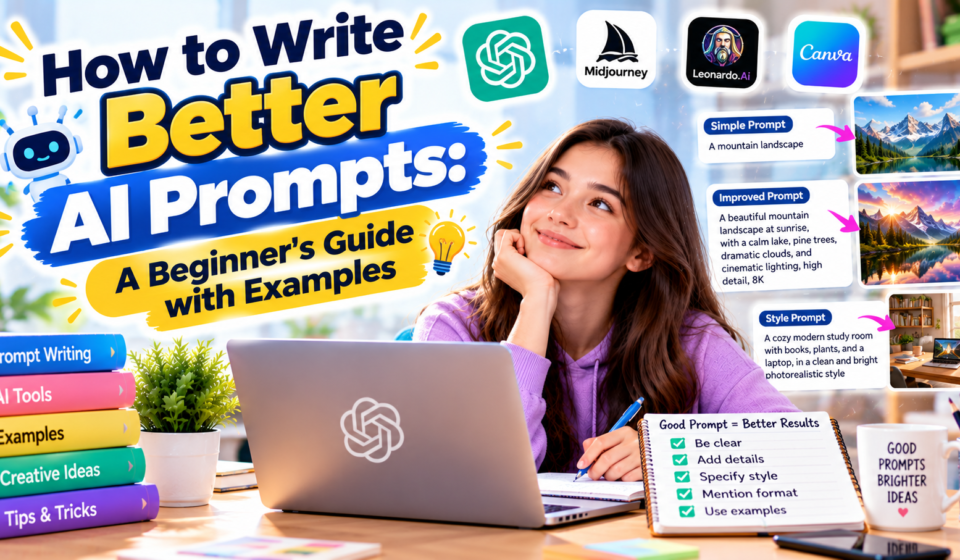

Artificial intelligence tools can produce useful results, but the quality of their responses often depends on the instructions they receive.
Learning how to write AI prompts is an important skill for students, professionals, bloggers, and business owners.
Clear prompts can reduce misunderstandings, improve relevance, and make AI-assisted workflows more efficient.
What Is an AI Prompt?
An AI prompt is a question, instruction, or set of information provided to an artificial intelligence system.
For example:
“Explain cloud computing in simple English.”
This is a basic prompt.
A more detailed prompt might be:
“Explain cloud computing to a beginner using three everyday examples. Keep the explanation under 300 words.”
The second prompt gives the AI more direction.
Why Does Prompt Writing Matter?
AI assistants can interpret instructions in different ways.
When a prompt lacks context, the response may be too general, too technical, or unrelated to your actual goal.
Providing specific instructions helps the AI understand what kind of output you need.
1. Define Your Goal
Begin by explaining what you want to accomplish.
Instead of:
“Help me with marketing.”
Try:
“Suggest five affordable digital marketing strategies for a small online clothing store.”
The improved prompt identifies a specific business and objective.
2. Provide Relevant Context
Context helps AI understand your situation.
For example:
“I run a beginner-friendly technology blog targeting readers in the United States. Suggest ten article topics about AI productivity tools.”
This provides information about the audience, website, and subject.
3. Specify the Output Format
You can ask AI to produce information in a particular format.
Examples include:
- A comparison table
- A step-by-step guide
- A short summary
- A professional email
- A blog outline
- A checklist
Choosing the format makes the response easier to use.
4. Define Your Target Audience
A beginner and an experienced professional may need very different explanations.
For example:
“Explain machine learning to a 12-year-old student.”
Or:
“Explain machine learning to a software developer familiar with Python.”
Audience details help adjust vocabulary and depth.
5. Set Clear Constraints
Useful constraints include word count, tone, reading level, and structure.
Example:
“Write a friendly 150-word introduction about cybersecurity for beginners. Avoid technical jargon.”
Constraints help guide the output.
6. Ask for Examples
Examples can make complex topics easier to understand.
Try:
“Explain API integration using an everyday business example.”
You can also ask the AI to compare two different approaches.
7. Refine Your Prompts
Prompt writing is often an iterative process.
If the first response is too complicated, ask for simpler language.
If it lacks detail, request additional examples.
If the structure is unclear, ask for headings and logical sections.
Useful AI Prompt Examples
For Blogging
“Create an SEO-friendly outline for an article about AI tools for freelancers. Include beginner-friendly headings and frequently asked questions.”
For Studying
“Teach me the basics of digital marketing through five short lessons. Ask me a practice question after each lesson.”
For Business
“Draft a professional customer service email responding to a delayed delivery. Use a polite and helpful tone.”
For Productivity
“Organize these tasks into a realistic workday schedule based on priority and estimated duration.”
Common Prompt Writing Mistakes
Avoid vague instructions that provide little context.
Do not assume the AI knows important details about your project.
Be cautious when requesting factual information because a well-written prompt does not guarantee an accurate response.
Always verify important claims independently.
Frequently Asked Questions
Do I need programming skills to write AI prompts?
No. Effective prompts can be written in ordinary language.
What makes a good AI prompt?
A good prompt clearly communicates the goal, context, audience, and expected output.
Can better prompts improve AI responses?
Often, yes. Clear instructions can improve relevance and reduce unnecessary revisions.
Conclusion
Learning how to write AI prompts can help you get more useful results from artificial intelligence tools.
Start with a clear objective, provide relevant context, and refine your instructions based on the response.
Explore more prompt-writing tutorials at AIDailyPilot.com.